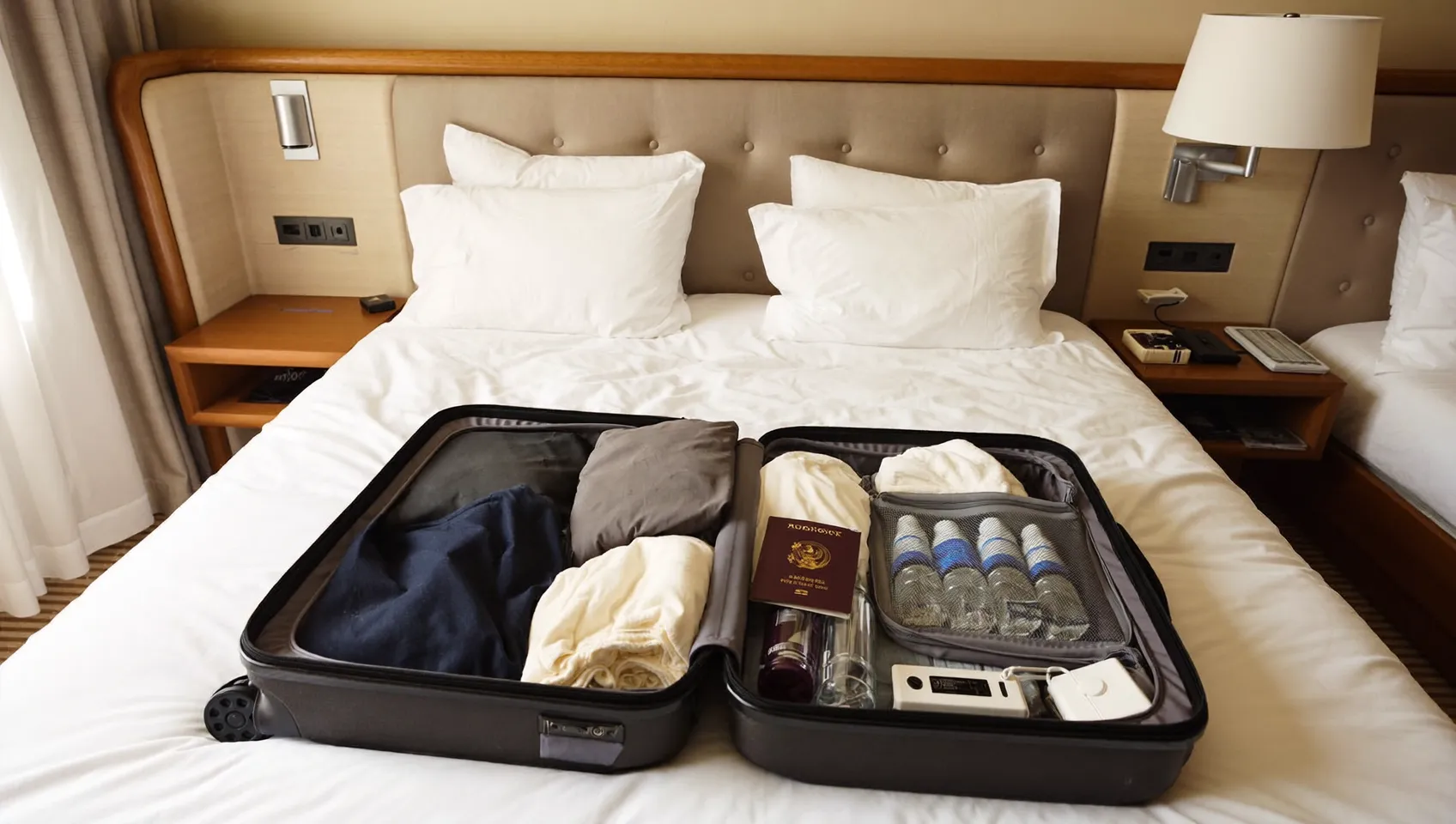
An international suitcase is built from five groups: documents, medication, electronics, clothing and care products. The liquid rule, common mistakes and a checklist are here.
A packing list for international travel should include these five groups: documents and payment methods, medication, electronics, clothing, and care products. Each liquid container in your carry-on must be no more than 100 ml; all liquids must be carried together in a transparent, resealable 1-liter bag. The list is built around this.
In brief
- Documents, medication, money and electronics should always be carried in your carry-on.
- Liquids must be in 100 ml containers, inside a transparent, resealable 1-liter bag.
- Choose clothing based on climate and laundry availability, not the number of days.
- Check your adapter, power bank and prescription separately before departure.
- Start preparing your suitcase with the list one week before departure.
The essence of the list: five groups
Prepare your suitcase group by group, not item by item. This way nothing is forgotten and you always know where everything is.
- Documents and payment: passport, visa, tickets, hotel reservation, insurance, cards and cash.
- Health: regularly used medications, prescriptions, first aid supplies.
- Electronics: phone, charger, power bank, adapter, headphones.
- Clothing: based on the climate of your destination and laundry availability.
- Care products: liquids, toothbrush, sunscreen, personal items.
The most important rule is this: valuable and indispensable items — documents, medication, money and electronics — go in your carry-on, not your checked baggage. Checked baggage may be delayed or lost; carry-on stays with you.
Documents and payment methods
The document group is the most critical part of the list. If something is missing, the trip cannot begin.
- Passport (check the validity period before departure)
- Visa or e-visa printout, if required
- Plane, bus and train tickets
- Hotel reservation confirmations
- Travel health insurance policy
- Debit card, credit card and a small amount of cash
- A driving license if you plan to rent a car; an international driving permit may be required depending on the country — see how to get an international driving permit and required documents for details
Take photos of all documents and save them on your phone; also send a copy to your family. The original documents and printed copies should stay in your carry-on, in a single folder; the backup you put in your suitcase should only be a digital copy. Since visa requirements vary by country, check the current rules for your destination before applying.
Carry-on luggage and the liquid rule
The liquid rule for carry-on luggage is the item that most often causes problems at the airport. The rule is clear: each liquid container must be no more than 100 ml, and all liquids combined must be carried in a transparent, resealable 1-liter bag.
What counts as liquid
Perfume, shampoo, toothpaste, cream, gel, deodorant spray and most makeup products fall into this category. Even if a container is only half full, if its size exceeds 100 ml, the rule still applies. For details on makeup items, see can you bring makeup on a plane.
Practical solution
Put large products in your checked baggage. Buy travel-size containers for your carry-on. Place the bag at the top of your luggage; you may be asked to take it out at the security checkpoint.
Banned and restricted items other than liquids, as well as baggage weight limits, vary by airline. Check your airline's current rules.
Health and medication
The basic rule for medication is to carry all of it in your carry-on and in its original packaging. If you take regular medication, bring a few days' extra supply beyond your travel duration; there may be delays or schedule changes.
- Regular medications and doctor's prescription
- Painkillers, fever reducers, stomach and allergy medications
- Band-aids, antiseptic, thermometer
- Glasses, contact lenses and spare lens solution (solution is subject to the liquid rule)
- Sunscreen and insect repellent
Some medications may be restricted or banned in your destination country. If you have medication that needs checking, get information from the relevant country's consulate or your health insurance company before you travel. Carrying an English copy of your prescription makes things easier.
Electronics and additional equipment
Electronic items are carried in your carry-on due to the risk of loss and damage.
- Phone and charging cable
- Power bank; it cannot go in checked baggage, carry it in your carry-on and check your airline's current rules for capacity limits
- Plug adapter suitable for your destination country
- Headphones, camera and spare memory card
- A multi-port extension cable, useful for group travel
The adapter is often forgotten. Plug types can change from country to country; make sure the adapter is in your bag before closing your suitcase. Research international data packages or local eSIM options for your phone in advance. Saving your destination city's map and reservation information offline is also a good habit.
Clothing: planning by climate and laundry availability
The amount of clothing you need is determined by climate and laundry availability, not the number of days. Ask in advance whether your accommodation offers laundry or dry-cleaning service; if it does, you don't need separate clothes for every day.
Basic approach
- Choose tops and bottoms that match each other; create many combinations with few pieces.
- Check the weather at your destination a few days before departure.
- Dress in layers: a thin sweater, a light jacket, a raincoat.
- Bring comfortable, broken-in shoes; new shoes can cause problems on walking tours.
- If you'll visit religious or cultural sites, add an outfit that covers shoulders and knees.
If you have an activity plan, add the appropriate equipment: hiking shoes, swimwear or a hat. Reading the itinerary on the tour page clarifies what's needed.
Common mistakes
The same mistakes recur when packing a suitcase.
- Putting documents in checked baggage. Your passport and medication should always stay with you.
- Carrying liquids without a bag. Liquids that don't comply with the bag rule cause problems at the security check.
- Not leaving room for the return trip. If you plan to shop, keep part of your suitcase empty.
- Forgetting the adapter. Check the plug type in advance.
- Putting valuables in checked baggage. Jewelry, cash and electronics should be carried in your carry-on.
- Not weighing your baggage. Exceeding the airline's limit can result in extra charges.
Another mistake is not reading the itinerary on group tours. The tour company may give extra recommendations for certain items. Read the itinerary and inclusions section on the international tours page before packing your suitcase.
Step-by-step preparation and checklist
Don't leave packing to the last day. Follow this order:
- Check your documents, visa and insurance one week before departure.
- Write your clothing list based on the weather.
- Separate your medications and prescriptions.
- Charge your electronic devices, find your adapter.
- Transfer liquids into 100 ml containers and put them in a transparent bag.
- Weigh your suitcase; check your airline's current rules.
- Save your ticket and reservation printouts to your phone one day before departure.
Final check:
- Passport and visa in carry-on
- Medications in original packaging
- Liquids in a transparent bag
- Power bank and electronics in carry-on
- Adapter and chargers ready
- Cash and cards placed separately
For trips requiring a visa, such as religious tours, the document list is especially important; for example, see documents required for Umrah.
Frequently asked questions
What should come first on a packing list?
Passport, visa, tickets and payment methods come first. Without these, the trip cannot begin. Carry all of them in your carry-on, in an easily accessible place.
What is the rule for carrying liquids in carry-on luggage?
Each liquid container must be no more than 100 ml. All liquids combined must be carried in a transparent, resealable 1-liter bag. Put large products in your checked baggage.
Should medication go in carry-on or checked baggage?
Carry your medication in your carry-on, in its original packaging. Checked baggage may be delayed or lost. Also bring a copy of your prescription.
Can a power bank go in a suitcase?
A power bank cannot go in checked baggage; it must be carried in your carry-on. The capacity limit may vary by airline. Check your airline's current rules.
Should I bring an adapter when traveling abroad?
Yes, your destination country's plug type may differ from Turkey's. Check the plug type before departure and bring a suitable adapter. Carrying the adapter in your carry-on prevents problems.
Do I need to leave room in my suitcase for the return trip?
Yes, if you plan to shop. Leaving part of your suitcase empty or bringing a foldable extra bag is a good solution. Check the baggage weight limit according to your airline.
Sources
- Items Not Allowed in Carry-on Luggage — enuygun.com
My Travel Team
Travel Editor
The My Travel team prepares up-to-date travel, visa and tourism information and guides.