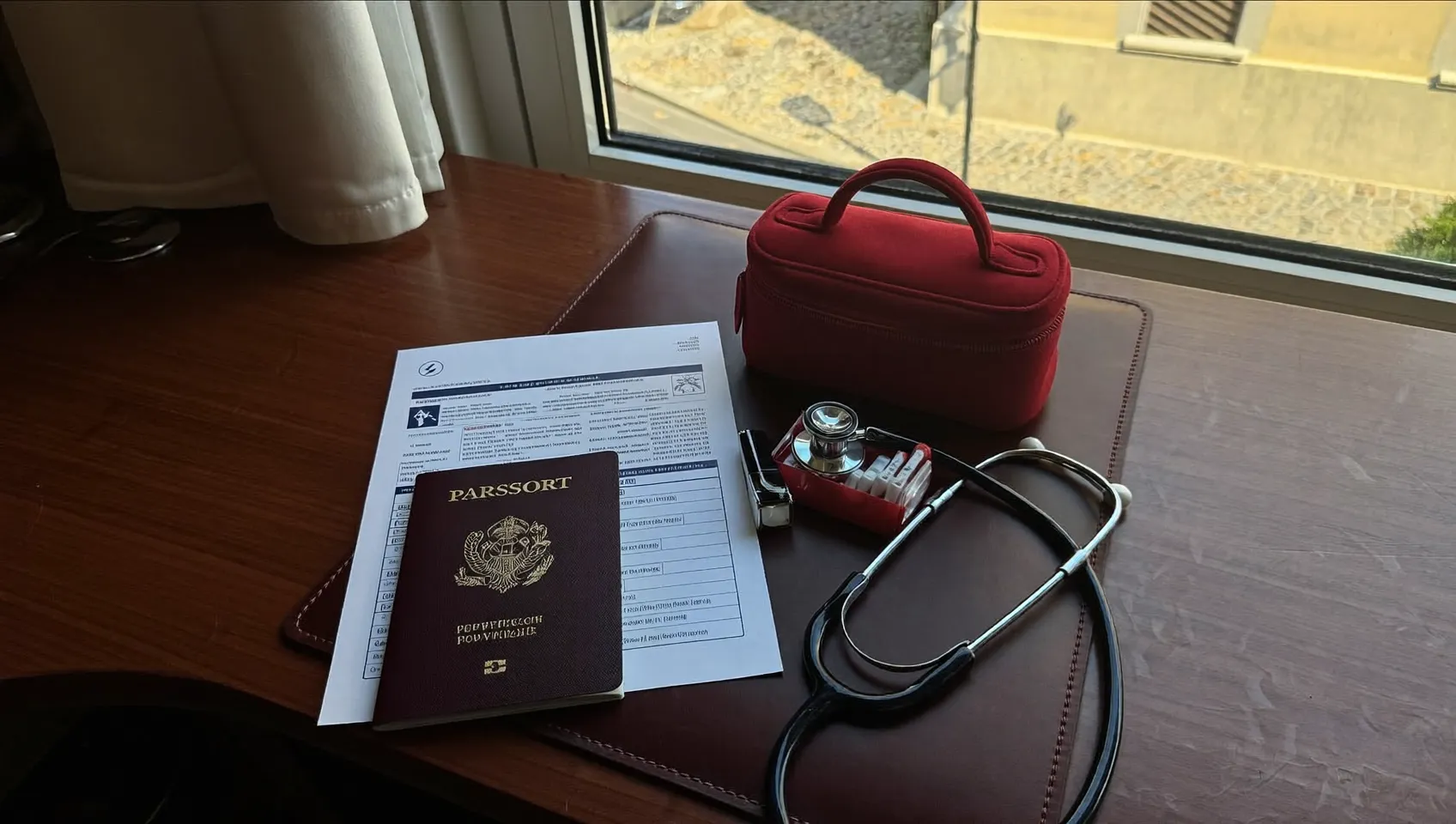
Travel health insurance has no fixed price. In this guide: starting prices by duration, factors that determine price, Schengen coverage requirements, common mistakes, and a pre-departure checklist.
The short answer to how much travel insurance costs is: there is no fixed price; a Schengen policy with €30,000 coverage starts at €3.49 for 7 days on one insurance comparison platform. The price varies depending on your age, travel duration and dates, the region you're traveling to (Europe or worldwide), the type of insurance, and the number of people insured.
In short
- No fixed price; age, duration, dates, region, insurance type and number of people determine the quote.
- For Schengen, at least €30,000 coverage is required; Allianz states the same threshold for the US, Canada and Japan.
- Price doesn't increase proportionally as duration increases; those traveling to Europe several times a year should consider an annual policy.
- If the return day, all Schengen countries, and medical repatriation aren't covered, the policy is insufficient for a visa.
- If you have a stop outside Europe, choose a worldwide policy; a European policy only covers that region.
What determines the price of travel insurance
Not everyone pays the same price for travel health insurance. The quote is personalized based on the risk calculation of the company issuing the policy. The main factors cited by insurance companies and comparison platforms are:
- Insurance type: A basic policy providing the minimum coverage required for a visa is not priced the same as a comprehensive policy with additional guarantees.
- Number of people: A single-person policy is priced differently from a family or group policy.
- Destination region: A Europe (Schengen) policy and a worldwide policy are priced separately; get separate quotes for each region.
- Age: Price varies based on the traveler's age; so a quote generated without entering your correct date of birth isn't final.
- Travel dates and duration: The price increases as the number of days covered by the policy increases, but the increase isn't proportional to the number of days.
So the amount a friend paid isn't a reliable benchmark for you. Even for the same route, differences in age and duration change the quote.
Coverage before price
When looking for a cheap policy, the real criterion is the coverage amount and scope. If the policy doesn't meet the required coverage and scope for your visa application, it will cause problems regardless of price. First find out your destination country's requirement, then compare prices among policies that meet that requirement.
Starting prices by duration
Starting prices seen for Schengen policies with €30,000 coverage on one insurance comparison platform are as follows:
- 7 days: €3.49
- 15 days: €3.98
- 30 days: €4.57
- 63 days: €5.24
- 90 days: €5.97
- 365 days: €14.37
A 7-day worldwide policy starts at €4.36 on the same platform.
The conclusion from these figures is clear: price doesn't double when duration doubles. The difference between a one-week policy and a one-month policy is small. If you'll be traveling to Europe more than once a year, consider an annual policy; however, annual policies may have a maximum number of days per single stay, so check this in the policy terms.
Things to note when reading these prices
- These are starting prices; the quote changes based on your age and dates.
- On the same platform, it's noted that only a single company offered quotes for Schengen policies up to 7 days during that period. So options may be limited for the shortest-duration policies.
- Prices are shown in euros; the amount you'll pay in Turkish lira depends on the exchange rate on the payment day.
Europe or worldwide: coverage requirements by region
Your destination country determines which policy you should get. A policy with at least €30,000 coverage is required for a Schengen visa. According to Allianz, countries like the US, Canada and Japan also require travel health insurance with at least €30,000 coverage during the visa process; confirm the current requirement for these countries from the relevant consulate page before applying.
Mandatory requirements for Schengen
A policy obtained for a Schengen visa must meet the following conditions together:
- Must be valid in all Schengen countries, not just the country you're entering.
- Must cover the entire trip, including the return day.
- Must provide at least €30,000 in coverage.
- Emergency treatment, hospital expenses, and medical repatriation must be included in the coverage.
If you're aiming for a multiple-entry or long-term visa, plan your policy duration accordingly; see our Schengen trusted traveler formula and 5-year visa guide for details.
Routes outside Schengen
If you have a stop outside Europe, such as the US, Canada or Mexico, choose a worldwide policy instead of a European one; a European policy only covers that region. Before heading to routes like the Cairo, Luxor and Aswan route in Egypt or an overwater villa holiday in the Maldives, check visa, entry and insurance requirements from consulates or official sources. Even if it's not mandatory, consider getting a policy to avoid paying out of pocket for healthcare expenses abroad.
Why lira prices appear so different
You'll encounter very different lira figures for travel insurance online. For example, the average price range on one service marketplace appears to be between 450 TL and 11,110 TL. This isn't an official source, and there are several reasons for such a wide range:
- Coverage differences: A policy that only provides the minimum required coverage for a visa and one with additional guarantees like baggage, flight cancellation, and personal liability are lumped into the same basket.
- Region differences: European and worldwide policies are included in the average together.
- Duration differences: One-week and one-year policies appear in the same list.
- Age and number of people: Quotes given to different age groups and family policies are grouped into the same average.
- Intermediary service: The policy on the marketplace may be sold by an agency or intermediary; a service fee may be reflected in the price.
How additional guarantees affect price
Some policies offer extra guarantees alongside basic health coverage. For example, one insurance company's policy provides €30,000 coverage for trips to Schengen, the US, Canada and Mexico, while also including refund coverage of up to €100 in case of visa refusal. Such additions are worth the price difference if they're useful to you; if not, a basic policy is sufficient. When deciding, look at the coverage you need rather than the total price.
Exceptions and common mistakes
Getting a cheap policy isn't the problem; the problem is traveling with a policy that doesn't meet the requirement. The most common mistakes are:
- Getting insufficient duration: If the policy doesn't cover the return day, it doesn't meet the Schengen requirement. If your flight is after midnight, add that day too.
- Getting a single-country policy: For Schengen, the policy must be valid in all Schengen countries.
- Skipping repatriation coverage: If medical repatriation isn't covered, the policy is insufficient for a visa.
- Traveling outside Europe with a European policy: On a route with transfers or multiple countries, choose the region that covers every stop.
- Not asking about pre-existing conditions: Chronic conditions may be excluded from coverage in many policies; read the policy terms.
- Assuming risky activities are covered: Activities like skiing and diving may not be included in a basic policy. If you have these planned, request additional coverage.
- Not reporting date changes: If your travel dates change, update the policy; an old-dated policy won't cover the new trip.
Is credit card insurance sufficient?
Some credit cards offer travel insurance. If you want to use it for a visa application, you'll need to be able to get a document that clearly states the coverage amount, the region of validity, and repatriation coverage. If this document isn't available, getting a separate policy is safer.
Getting the right policy step by step
Getting a policy takes just a few minutes, but you need to follow the right order:
- Clarify your route. Determine which countries you'll visit and your entry and exit dates.
- Learn the coverage requirement. At least €30,000 coverage is required for Schengen. Allianz states the same threshold for the US, Canada and Japan; check the current requirement for these and other countries from the consulate page.
- Choose the region. If it's only Schengen countries, choose Europe; if you have a stop outside, choose a worldwide policy.
- Determine the duration. Calculate the number of days including departure and return; leaving a day or two of margin makes things easier for your visa application.
- Enter personal information correctly. Write your name and surname as on your passport, enter your date of birth correctly; price varies by age.
- Compare quotes. Compare prices among policies offering the same coverage and scope; decide whether additional guarantees are really necessary for you.
- Check the policy. The coverage amount, region of validity, date range, emergency treatment and repatriation coverage should be clearly stated in the document.
- Keep the document. Get a digital and printed copy, and save the emergency assistance hotline number on your phone.
You can get a policy that meets visa requirements directly from our travel health insurance page by selecting your destination region and dates.
Pre-departure checklist
Check off this list item by item before heading to the airport:
- Coverage: Does the policy state the coverage required by your destination country (at least €30,000 for Schengen)?
- Region: Does the policy cover all the countries you're visiting, including transfer points?
- Dates: Are your departure and return days within the policy period?
- Scope: Does it state emergency treatment, hospital expenses and medical repatriation?
- Personal information: Do your name, surname and date of birth exactly match your passport?
- Additional coverage: Are planned activities like skiing or diving covered?
- Documents: Is a printed copy of the policy in your bag and a digital copy on your phone?
- Emergency line: Is the insurance company's international assistance number saved?
If insurance is sorted, move on to flight preparations: complete the online check-in steps and check the power bank rules for flights for electronic devices in your cabin baggage. If you get sick abroad, call the insurance's emergency assistance hotline first; reimbursement for expenses paid without authorization can be difficult with many policies. Keep the invoice and report for every medical expense you pay.
Frequently asked questions
How much does travel insurance cost for a Schengen visa?
On one insurance comparison platform, a Schengen policy with €30,000 coverage starts at €3.49 for 7 days and €4.57 for 30 days. The exact price varies based on your age, travel dates and the type of policy you choose.
What is the minimum coverage required for travel insurance?
For a Schengen visa, the policy must provide at least €30,000 in coverage. Allianz states that a policy with at least €30,000 coverage is also required during the visa process for the US, Canada and Japan. Check the current requirement for these and other countries with the relevant consulate.
How much is annual travel insurance?
On one comparison platform, a 365-day Schengen policy with €30,000 coverage starts at €14.37. If you'll make more than one trip to Europe during the year, this may be more practical than getting separate policies each time; check the maximum stay limit per trip in the policy terms.
Is worldwide travel insurance more expensive than a European policy?
In the 7-day example on one comparison platform, it appears so: a worldwide policy starts at €4.36, while a Schengen policy of the same duration starts at €3.49. It wouldn't be correct to draw a general rule from a single example; price both regions separately for your own dates. If you have a stop outside Europe, choose a worldwide policy.
Does age affect the price of travel insurance?
Yes, the price of travel insurance varies based on the traveler's age. Since the size of the difference can vary by company and policy, get a quote by entering your correct date of birth.
What should Schengen insurance cover?
The policy must be valid in all Schengen countries and throughout the trip, and must provide at least €30,000 in coverage. Emergency treatment, hospital expenses, and medical repatriation must also be included in the coverage.
Is the insurance fee refunded if the visa is refused?
This varies from policy to policy. Some insurance companies offer refund coverage of up to €100 in case of visa refusal. Check whether a refund condition is stated in the policy terms before purchasing.
Sources
- What Should Travel Health Insurance for Schengen Be Like? — turkiyesigorta.com.tr
- Get a Quote for International Travel Health Insurance — allianz.com.tr
- Travel Health Insurance with €30,000 Coverage — tamamliyo.com
- Travel Health Insurance Prices 2026 — armut.com
My Travel Team
Travel Editor
The My Travel team prepares up-to-date travel, visa and tourism information and guides.